
Beat Your Fear of Heights, (like I have)
For years as a climber I was held back by my acrophobia (fear of heights), my head panicking pretty much the moment I was about a meter or two above the ground. Possibly my fear kept me alive, but even as I learned more about how I should be doing things safely, my fearful head still kept talking me out of it. I desperately wanted to enjoy the adventure, but couldn’t actually face the reality! I needed to beat my fear of heights.
Over the years I have made it a goal not to let my head ruin my adventures any more. This is what I have learned …

Understanding Acrophobia / A Fear of Heights
The psychological brain
In Professor Steve Peter’s book, the Chimp Paradox, Peters focuses on three parts of the brain: the limbic, the frontal and the parietal. For the reader he calls these, the chimp, the human and the computer. (He accepts that this is a huge simplification of the psychological mind – but I find it works well for me, the layperson).
The chimp is the emotional part of the brain. It thinks and responds to stimuli faster than the human, and it is the more dominant of the two. The human is the rational, logical part of the brain that can think things through and come to a more objective conclusion for any stimuli or information presented to it. The computer enables us to do things automatically: everyday actions such as how to walk, drive a car or put on your clothes (which Peters describes as auto-pilots). But also the computer banks information on how we have dealt with past situations or stimuli and gives us a reference point for either the chimp or the human to refer to.
How we read the world around us
The stimuli of how we read the world around us come with our senses, and largely these will be visual, audio and/or kinaesthetic. A visual stimulus is what you see, real or imagined. The audio is what you hear, including your inner-voice (telling you not to carry on maybe). It could also be the sound of a howling gale, reminding you that these are serious weather conditions. The kinaesthetic is how we physically relate to the world around us. It might be the awkward slope of the hillside we’re stood upon or the slippery nature of wet shiny rock feeding us information that we’re not in a safe or secure place.
When we are presented with a stimulus, our chimp is the part of the brain that manages this information first. It will need to make a decision as to which part of the brain is best placed to deal with any given stimulus. For example someone you know, waves at you from across the street, the chimp may ask “computer, that’s a friend waving at us, what do we do?” and the computer, on auto-pilot now, is already responding to the stimulus in micro-seconds by making you wave back.
The stimulus, might be something very new however. For example, as you navigate down a path in a foreign, tropical country a large lizard-like creature presents itself. The chimp may then engage in a conversation with the computer and/or the human before it works out a plan. It’s also on the cusp of allowing the amygdala (which is an integral part of the chimp) to take over.
Acrophobia and amygdala hijack
The amygdala, which is about the size of an acorn, is even poorer at thinking things through than the chimp. However it is really good at dealing with fight, flight, freeze situations.
And so, if for example, you’re driving at speed along the motorway, and the car in front of you suddenly brakes, when you see those brake lights glaring up at you and getting exponentially larger as you approach the tail-end of that car, your amygdala takes over. This is called amygdala hijack. The amygdala physically takes the lion-share of oxygenated blood-supply from the rest of the brain and literally takes over. In a split second it will pump the body full of adrenaline, raise the heart rate and issue orders: “Pump the brakes! Turn left! Straighten up! Brake some more! Look for space!” and so on.
Once you have survived the encounter, the chimp thanks the amygdala for its life-saving actions, and then the computer stores the memory in case of need in the future.
A bit more on the computer …
It’s efficient for our brains to learn how to do things automatically and that way we can do more than one thing at once. So, when children are growing up, they learn things like how to walk, or how to throw and catch a ball etc. (whilst breathing, talking, laughing and a myriad of other things that we take for granted). As they practice these actions, and repeat them they are sending signals up and down their body to the brain and thus creating these neural pathways to make the actions automatic. The same is true for our patterns of behaviour…
So if every time we are faced with what we perceive to be a scary stimulus, and we stop, have a moment of panic and then retreat, what we are doing is strengthening those neural pathways, and making this behaviour-set happen more readily and naturally in the future. That is why unless we address these issues they will continue to dominate our actions.
Develop an awareness of your chimp
Reflect at the end of each, and every day, and consider when your chimp would have been ruling your actions. Minor road-rage in your car? How you were unduly hurt by someone’s ill-considered words? Retreating off a climb you know you can do? Learn to recognise when your chimp is acting up.
In his book, Peters talks about managing the chimp by exercising it, boxing it and offering bananas. By this he means that you should allow your chimp to express itself, appropriately. Don’t try to deny its existence: let it talk. By boxing it, he means, be prepared to be able to debate with it, feed it reasoned facts and truth to counter its emotional dialogue. And finally be prepared to distract it from time to time, or reward it. In essence, be aware of this part to your brain, and in those calm moments of your life, allow time to reason with it.
Now start to visualise yourself doing stuff that you really want to do.
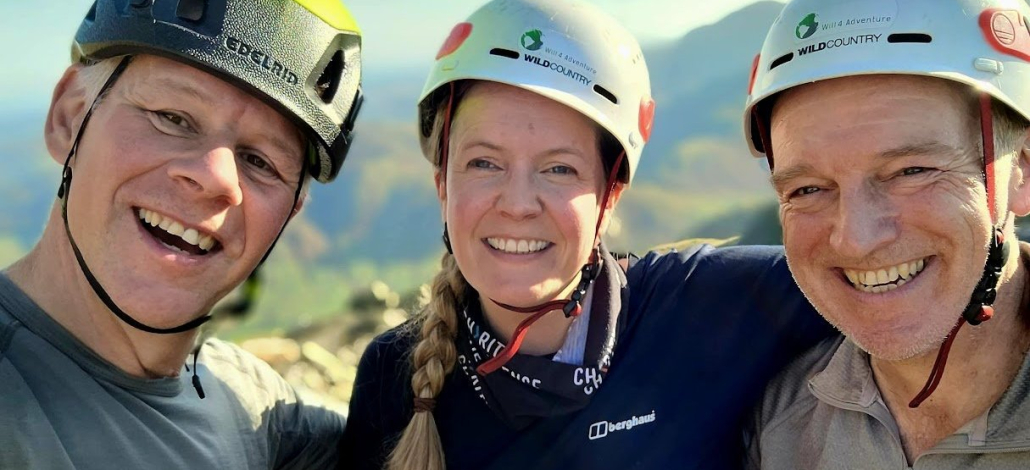
Start to anticipate how you might be able to behave differently in future
What triggers your acrophobia? For a walker it might be walking towards an edge, or along a ridge-line. For a climber this might be as you climb above your last bit of gear. What do you do in these situations?
Is this now a learned sequence that the brain’s computer now has on auto-pilot? With a greater awareness of how and when your chimp can rule your actions, you are better placed to arrest this sequence of events somehow, the next time it starts to occur. You need to stop that amygdala taking over.
Stop the amygdala hijacking the brain – do some hard sums
The amygdala is only small and while it’s good at making you do something quick in order to survive, it is no good at thinking things through. The frontal lobes of your brain (which form the ‘human’) are the thinking, clever, rational part of your brain. This is the part of your brain you want to be doing the thinking in order to stop that flow of panic.
However, as your chimp starts to get over-excited it hogs all the oxygenated blood. To release the chimp’s grip of you and to make the frontal lobes work instead, try and solve a hard task, like reciting your phone number backwards. The amygdala is too small to do this. It’s like asking a ZX81 home computer from the 1980s to do a task of a modern smart phone: it just can’t do it. Eventually it gives up and sends this harmless problem to the frontal lobes, which then allows you to start processing information more rationally.
Anticipate, act, repeat
Just outside the edge of your comfort zone is where you will start making progress. Obviously for different people that’s in different places. What you need to do (now) is write a bucket list of objectives that you want to achieve.
Go out and do something you know will challenge your chimp. When it starts to flare up, simply stop. Acknowledge what’s happening. Say your phone number backwards out loud and breathe. Ask yourself if maybe, you might go on, just a little bit more. At some point, you will have to stop and turn back, but you will have disrupted the pattern, and started to rewrite your script by your design! Reflect on how this can be the new you.
Once again, visualise yourself doing stuff that you really want to do. Start to see that it really is a possibility.
Go out, and repeat this all again on another day. See how far you get.
And breathe
Typically people hold their breath or hyper-ventilate when they are in a state of panic. When they are relaxed, their breathing is relaxed too. Breathe, and try to breathe in a relaxed way. This is another way to send a kinaesthetic stimulus to your brain that all is well.
And if it all goes wrong …
You will still have your moments. If you do have a panic out there, manage the situation as follows:
Remember the amygdala is the small part of your brain which controls emotions, the fight or flight response (fear) and impulsive behaviour. When you’re on the edge and fearing for your life it’s this acorn-sized bit of your brain that’s doing the work … but it’s your cerebral cortex (the clever, rational thinking part) that needs to be.
- Start breathing – stop holding your breath (you will be). Take TEN deep breaths. Count them in and out.
- Distract your brain, start forcing it to think. You really really must do this. For example say out loud your mobile phone number in reverse. This will help to engage your rational thinking cerebral cortex, and this will begin to calm you down.
- Visualise someone you know (or James Bond for me) who is really confident with heights – pretend you are them in this exact situation. (I hum the James Bond tune too which also helps keep my cerebral cortex working).
- Visualise yourself at the top or at the next safe place and see how much nicer that will be for you. When you get to that spot, acknowledge that you managed it once, you can manage it again.
- Keep that cortex working – tell yourself your mobile phone number in reverse again. Keep breathing.
- Thinking head now engaged – start thinking and looking. Break this challenge down into small chunks. This might start by just letting go with one hand at a time, maybe dropping your heels or just taking a single step. Keep breathing.
- Once out of immediate trouble, take the time then to plan each step to the next safe platform.
The future
A lifetime of programming your brain to behave in the way it does takes a journey to undo, so do not expect changes in yourself to be a light switch moment. But you can definitely turn things around for yourself.
From here on promote positive expectations for yourself. Be positive in the way you regard and describe yourself. Stop telling people that you are afraid of heights. Pessimists think bad things are forever. Be an optimist, accept bad things as temporary setbacks and accept that these will occur within the wider scope of life. There will be blips on this journey when you have a bad day out but you won’t always have a bad day. Stay positive and you will know that the good achievements will continue.
Good luck with the journey!
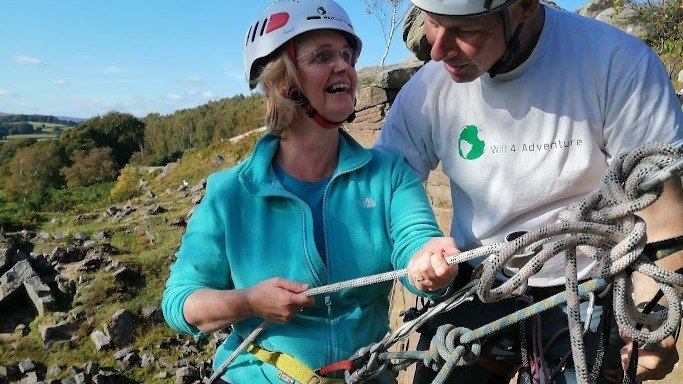
What do we do to help people with acrophobia on our fear of heights courses?
In essence we help you by changing your brain’s narrative … First of all we use a therapist to work with your brain at a subliminal level. The message is placed in your brain that you no longer need to behave in the way you do. Then we work with you at a very practical level, outdoors.
We run through a series of exercises, slowly taking you out of your comfort zone, but always keeping an eye on you, and always offering help and support. You’re never under any pressure to complete an exercise, and always we’re reflecting on how your brain is responding to these changing circumstances, and reflecting on the progress you’re making.
I would say everyone who joins us for these courses, really enjoys themselves and for maybe 90% of people who join us, their lives are changed for the better forever!
Finally …
Every year we know hundreds of people will click on the link for our Overcome Your Fear of Heights course page. Of those, only scores actually decide to go ahead and book themselves on with us. If you become one of those, well done, you are well on your way to finally nailing this demon.
Will Legon (of Will4Adventure.com) works professionally in the outdoors leading groups walking and instructing single pitch rock climbing. Since 2006 Will and his team from Will4Adventure have been helping hundreds of people overcome their fear of heights.


Fear of Heights FAQs
What time does the course start & finish each day?
Normally we meet at around 0915 each day. The first day is quite a big day and so you shouldn’t be surprised if we’re not done before 6pm. We’re normally done by 1700 at the very latest on day 2.
I don’t drive. Can I use public transport to get to you?
Yes – totally! Book accommodation in Bamford, Hope or Castleton. (Hope and Bamford are both served with rail and bus connections). Let us know you’re not driving and we’ll see what we can do to find you a lift-share for each day. It’s never a problem and actually helps with the limited car parking.
What accommodation should I book and where?
Ok first off – please don’t be tempted to get up at 5am and to travel up on the day of the course. You will get the most from this course if you’re not already tired. But also, things happen and we don’t want you to miss the start of the day with Alison.
Now for the second part of the question … Castleton has a really good range of accommodation to suit all budgets including B&Bs, a youth hostel and a campsite. But for people travelling by train, Bamford might be best for you since there’s a station there and this is where the course meets/commences on the first day.
Am I too old to overcome my fear of heights?
No. Years ago I trekked for five days across Devon with my mother-in-law, who is 24 years older than me. We each carried our own backpacks complete with food and tents. Some days we would arrive at the campsite having covered 20 miles. I would be shattered and she looked like she could do it all again. In my experience, fit capable people come in all ages.
I am overweight. Will that be a problem?
There’s no weight limit, but you do need to have a waist size of 56″ or less (so that we can fit you with a harness).
I’m not convinced I’m fit and strong enough for rock climbing and abseiling – how fit do I need to be to do your course?
You don’t have to be very fit to complete this course. On the first day we walk maybe a mile in total, and on the second day, maybe two miles. The activities we do on the course really don’t require arm strength – we’re certainly not expecting any ninjas or athletes to turn up, just normal people, in all shapes and sizes. If you can cope with the distances, and can do things like climb up a ladder out of a swimming pool, or step up onto a park bench, you will be absolutely fine.
I am REALLY afraid of heights. Is this the right course for me?
Have you / your instructors got the patience to deal with how I react to heights? As a worst case scenario my fear manifests itself (very embarrassingly) in me trying to get as close to the ground as possible and often tears.
It is exactly for people like you, that this course exists. You may well cry, it does get emotional sometimes, and that is totally ok. It might even be that other people cry too. But, we are really good at supporting people and helping people with the challenges we put out there. Also, we’re really good at gauging how things are, and tempering each challenge accordingly.
How large are the overall group sizes?
The group sizes are usually between 6 and 10 people, and we work at a ratio of 1:4. Rarely more than 8, and rarely fewer than 4. The group dynamic is really healthy though: people often support each other through the challenges and actually form friendships too.
I have previously done an ‘outward bound course’ (abseiling, bridge jumping, high ropes etc) to try and overexpose myself and overcome my fear but that didn’t help. Mainly as there was a lot of shouting & telling me to ‘get on with it’. How will this course be different?
The experience your describe is the worst way to overcome your fear of heights. I can’t imagine it was positive at all for you and it probably only reinforced your fears. Our approach is hugely different. We’re really good at nudging you slowly and incrementally out of your comfort zone and there is zero pressure or coercion from anybody. The experiences and successes have got to be yours! Otherwise they’re meaningless.